
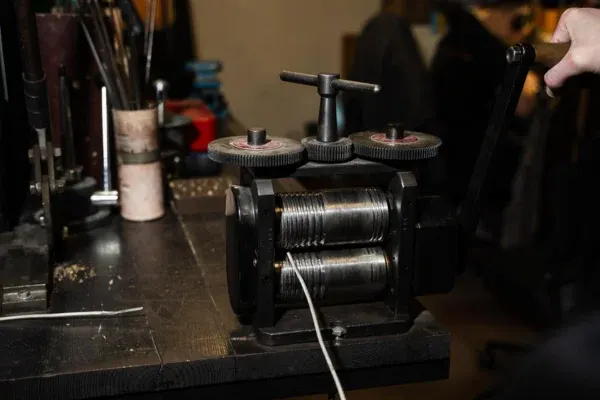
Wire That Feeds Consistently, Pass After Pass
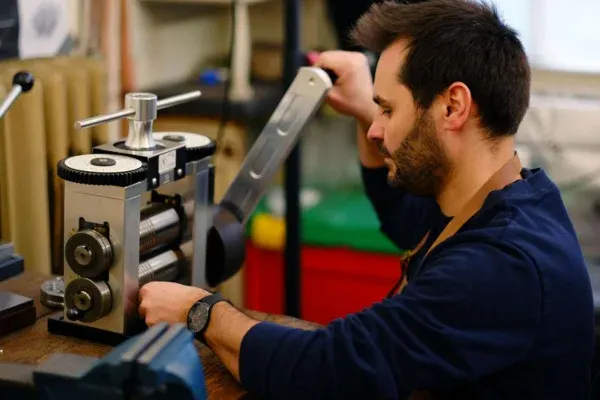
Wire work has its own set of demands that sheet rolling simply doesn’t share. A wire that comes out slightly oval instead of round, or one whose gauge drifts even a fraction across its length, causes real problems downstream — chain links that don’t sit evenly, settings that don’t seat properly, and wasted material when a length has to be scrapped mid-batch. Our gold wire rolling mill was engineered specifically around solving that problem.
Rolling wire isn’t just a scaled-down version of rolling sheet. The roller groove profile, the pressure distribution, and the feed mechanism all need to work together differently to produce round, consistent wire rather than flat stock. That’s where we’ve put our engineering focus with this machine.
Groove-Profile Rollers Built for True Roundness
Our wire rolling mill uses precision-machined groove rollers designed to maintain true roundness as the wire passes through successive reduction stages. A lot of lower-quality machines let the wire go slightly oval as gauge decreases, which isn’t always obvious until the wire reaches a customer and doesn’t behave the way round wire should during further processing, like drawing or chain-making.
We’ve calibrated the groove profiles specifically to avoid that drift, so the wire holds its roundness whether you’re doing a light gauge reduction or taking it through multiple passes to reach a much finer diameter.
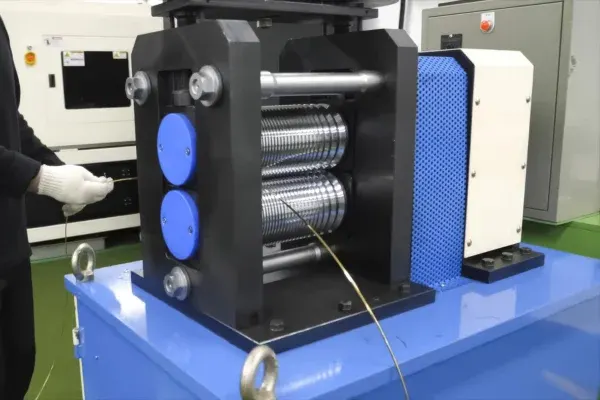
Built for Chain-Making and Wire-Based Jewellery Work
A significant share of gold wire produced on rolling mills feeds directly into chain-making processes, where consistency isn’t optional — it’s the difference between a chain that looks uniform and one that shows visible irregularities link by link. Our machine is built to give chain manufacturers wire they can rely on without needing to sort or reject sections for gauge inconsistency.
Beyond chain-making, this mill also suits wire destined for settings, clasps, and other structural jewellery components where dimensional accuracy matters as much as surface finish.
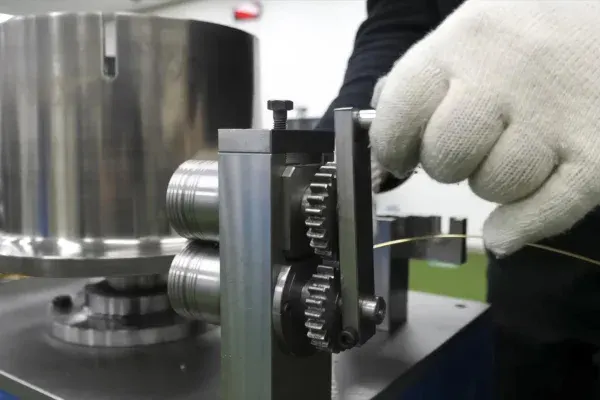
Handling Gold's Behaviour During Wire Reduction
Gold responds differently under wire-rolling pressure compared to sheet rolling, given the concentrated contact area of grooved rollers versus flat ones. Our machine’s pressure settings are tuned specifically for this, reducing the risk of surface cracking or inconsistent hardening that can occur when gold is rolled through grooves at inappropriate pressure levels.
This attention to gold’s specific material behavior is what separates a purpose-built wire rolling mill from a general rolling machine adapted for wire work.
Reliable Across Long Production Runs
Gauge consistency matters just as much at the end of a long production run as it does at the start. Our wire rolling mill is built with hardened components that resist wear and calibration drift, so wire produced late in a shift matches wire produced at the beginning.
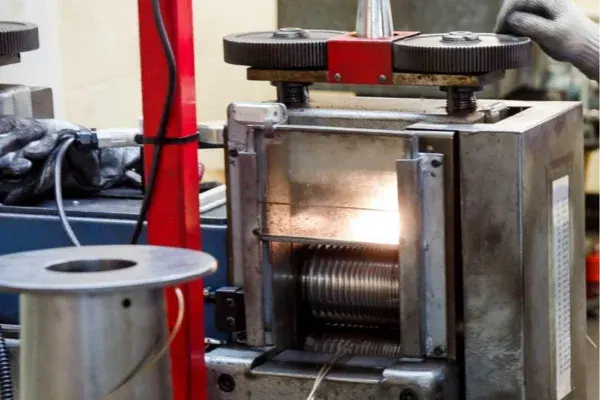
ISO 9001:2015 Certified Manufacturing
Every wire rolling mill we manufacture goes through structured quality checks under our ISO 9001:2015 certification, covering roller calibration, groove accuracy, and performance testing before it leaves our Ahmedabad facility.
Who This Machine Suits
This mill is built for manufacturers whose production depends on consistent wire gauge and roundness, particularly chain makers and jewellery producers working with wire-based components. If wire is a core material in your production line, this machine is engineered around exactly that requirement.
Reach out to our team to discuss your wire gauge range and production volume.
FAQS:
Why does gold wire rolling need different rollers than sheet rolling?
Wire rolling requires precision-machined groove rollers to maintain true roundness, while sheet rolling uses flat rollers — the two processes need different roller profiles to produce accurate results.
Is this machine suitable for chain-making applications?
Yes, it’s specifically built to produce consistent-gauge wire suitable for chain-making, where uniformity across the wire length is essential.
Does gauge accuracy hold up during long production runs?
Yes, the machine’s hardened components are designed to resist wear and calibration drift, maintaining consistent gauge even during extended runs.
Can this mill handle multiple wire gauge reductions in sequence?
Yes, it’s built to take wire through successive reduction passes while maintaining roundness and dimensional accuracy at each stage.